













Transaction Center
Time to bring it home. Find zipForm®, transaction tools, and all the closing resources you'll need. Except for the champagne — that's on you.
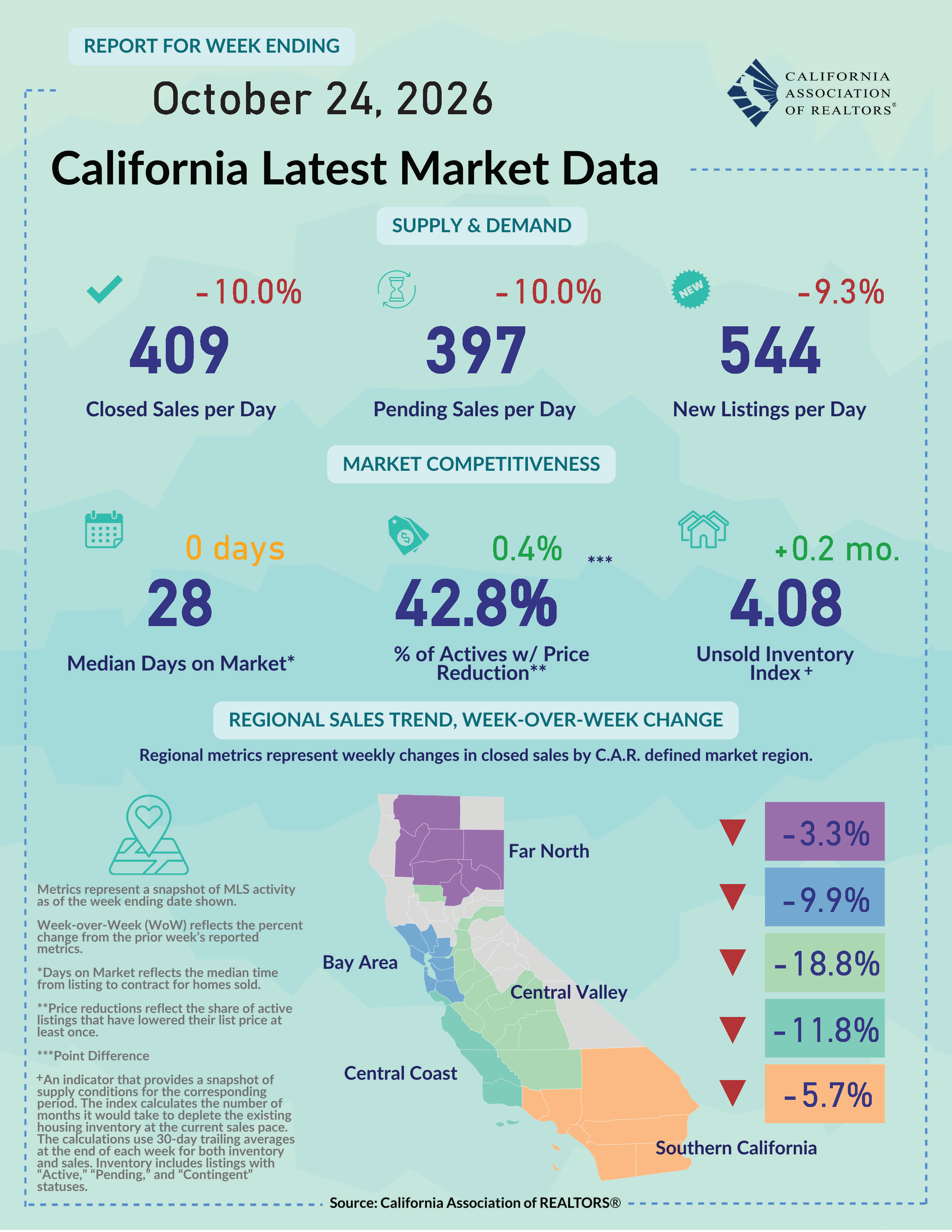
View the latest sales and price numbers. Find out where sales will be in upcoming months.
Get a roundup of weekly economic and market news that matters to real estate and your business.
Gain insights through interactive dashboards and downloadable infographic reports.
All Shareable Reports All Interactive DashboardsCatch up with the latest outreaches and webinars by the Research and Economics team.
C.A.R. conducts research with members and consumers on a regular basis to get a better understanding of the housing market and the real estate industry.
California Model MLS Rules, Issues Briefing Papers, and other articles and materials related to MLS policy.
Looking for information on how to file an interboard arbitration complaint? You've come to the right place! Find the rules, timeline and filing documents here.
Summaries and photos of California REALTORS® who violated the Code of Ethics and were disciplined with a fine, letter of reprimand, suspension, or expulsion.
The most recent edition of the Code of Ethics and Standards of Practice of the National Association of REALTORS® along with other important links to NAR information.
The California Professional Standards Reference Manual, Local Association Forms, NAR materials and other materials related to Code of Ethics enforcement and arbitration.
Designed to expand housing access, Proposition 37 proposes a $25 billion state bond program providing eligible middle-income homebuyers with fixed-rate second mortgages covering up to 17% toward the purchase of newly constructed homes.
Updates on C.A.R.'s legislative advocacy efforts in Sacramento.
Ballot MeasuresIssues briefing papers, handbooks and other background materials on local policy issues that affect real estate.
CREPAC, LCRC, IMPAC, ALF and the RAF comprise C.A.R.'s political fundraising arm.
The RAA: Protecting REALTORS® and Homeownership REALTOR® Action FundC.A.R. Senior Vice President of Government Affairs Sanjay Wagle sits down with California Insurance Commissioner Ricardo Lara to discuss the current state of California’s insurance market,
Learn how you can make a difference, by getting involved yourself or by passing along valuable information to your clients.


|
October 26, 2026 - With interest rates remaining elevated and housing demand likely to soften in the next couple months, confidence levels resumed their declining trend not only for consumers but for builders and business leaders as well. Builder confidence has sunk to a 14-year low in the latest report, with new construction activity dipping to the second lowest level since early 2020. Corporate CEOs are also growing pessimistic about the economic outlook, with many expecting conditions to worsen in the short term. Still, the labor market continues to hold steady, with jobless claims falling despite the ongoing economic uncertainty. With neither employment nor inflation providing a clear signal that a policy rate hike is imminent, the Federal Reserve is expected to hold rates steady in the upcoming FOMC meeting. Builder Confidence Falls to Lowest Level Since 2012: The National Association of Home Builders/Wells Fargo Housing Market Index (HMI) showed builder confidence fell 3 points to 29 in October, its lowest level since June 2012. The share of builders cutting prices increased again by five points and reached 43%, the highest level during 2020–2026 period. Meanwhile, the average reduction was held steady at 6% for the seventh consecutive month in October. Sales incentives were used by two-thirds of builders (65%) last month, and it was the nineteenth consecutive month with 60% or more builders using the approach to stimulate demand. All three components of the HMI declined, with the index on current sales conditions falling two points to 33, the lowest level in more than 14 years. Future sales expectations also dropped five points to 32 and reached the lowest point since November 2022. Traffic of prospective buyers was down five points to 18 and declined to the lowest point since April 2020. The drop in builder confidence was largely driven by the recent surge in mortgage rates and high material costs, which will remain headwinds for both the supply and the demand sides for the rest of 2026. High Costs and Weak Demand Continue to Slow New Construction: US housing starts fell 5.2% month-over-month in September to 1.221 million units, dropping to the second lowest level since the COVID-19 pandemic. Single-family starts, which account for much of homebuilding, dropped 4.6% to 859k units from August’s 900k, while multifamily starts fell 7.2% from the prior month to 349k units. Total permits authorized in September also edged down 0.2% to 1.4M units and were down 3% from 12 months ago. Single-family permits declined 4% to 845k units and reached the lowest level since March 2023. Elevated mortgage rates, high material costs, and weak demand continue to weigh on construction, discouraging builders from starting new projects. Rising Risks Weigh on CEO Confidence: CEO confidence fell six points to 46 in Q4 2026 from Q3 2026 and reached the lowest level since Q2 2025, according to the latest survey results released by the Conference Board. An index reading below 50 indicates more negative than positive responses. Among the CEOs surveyed, 37% of them said economic conditions have worsened from six months ago, a notable increase from 26% reported in the previous quarter. Looking ahead, 13% of CEOs expected economic conditions to improve over the next six months, down from 25% recorded in Q3 2026. CEOs ranked cybersecurity (71%), AI and new technology (64%), and geopolitical tensions (58%) as the top three industry risks, with concern rising sharply for all of them from last quarter. Despite lower confidence, more than half of CEOs plan to maintain their existing capital investments (53%), while over a third plan to increase their capital spending (36%). Initial Unemployment Claims Hit Lowest Since Mid-July: Initial applications for unemployment benefits fell to a seasonally adjusted 194,000 applications for the week ending October 17, the Labor Department reported last week. Despite a mild rebound in the previous week, the latest jobless claims figure is the sixth straight week that claims have been at or below 200,000. Although initial claims fell, continuing claims rose by 25,000 to 1.728 million but remained below the levels observed in late June when the number of people receiving unemployment benefits was above 1.8 million. The latest report continues to suggest that even with low consumer confidence in the economy, the labor market is holding steady, which could be a reason for the Fed to pause on additional rate hikes in the upcoming meeting. California Homeowners Cautious of AI for Housing-Related Decisions: The 2026 C.A.R. Homeowner’s Survey found that most homeowners are cautious about using AI on making any of their housing-related decisions. The latest survey results conducted in the fall was based on responses from about 1,000 homeowners in California. Most of them (66%) have never used AI for housing-related decisions. Among those who have, they used it primarily for estimating home value or price, finding homes that meet their preferences, and getting renovation suggestions. Trust in AI is divided among homeowners, with accuracy of information (57%) and privacy concerns (40%) as top concerns of using AI in real estate. With trust and lingering concerns around AI, 81% of homeowners would still want a human expert to verify AI-generated recommendations. For future home purchases, nearly half of homeowners (47%) are unlikely to use AI tools for their next housing decision, and more than a third of homeowners (37%) would prefer AI not to handle any of their future housing tasks. Despite these reservations, homeowners see a role for AI in home searches (36%) and pricing and valuation (27%). Note: This summary report gets updated every Monday by 6:00 pm PST. Feel free to email us at [email protected] if you have any questions and/or feedback.
|
|